The short answer
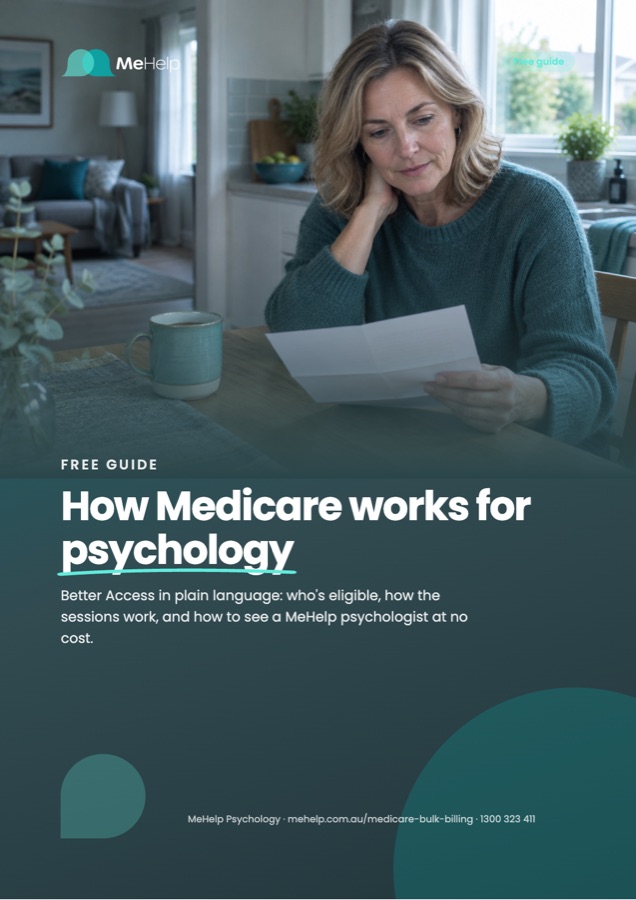
How Medicare works for psychology
Medicare's Better Access initiative pays a rebate for up to 10 individual psychology sessions each calendar year. You need a Mental Health Treatment Plan and a referral from your usual GP or your MyMedicare practice. Sessions come in a first course of up to 6, then a GP review for the rest. At MeHelp, sessions are bulk billed for eligible clients, so there's no gap to pay.
A look inside
From the guide
The basics
What Better Access covers
Better Access is the Medicare program that helps pay for psychology. It's for people with a diagnosed mental health condition, such as anxiety or depression, who need at least a moderate level of support.
Individual
Up to 10 sessions a year
Rebated one-on-one sessions each calendar year (1 January to 31 December). Up to 2 of them can involve a family member or carer, where that helps your treatment.
Group
Up to 10 group sessions
A separate allowance for group therapy. Group sessions don't use up your 10 individual sessions.
How the sessions are structured
Plan and referral
Your GP prepares a Mental Health Treatment Plan and writes a referral. The referral says how many sessions it covers.
First course of up to 6
You see your psychologist for up to 6 sessions. They then send your GP a short written update.
Review with your GP
Your GP reviews how things are going and can refer you for the remaining sessions, up to 10 in the calendar year.
Common questions
What people ask
Do I need a Mental Health Treatment Plan to see a psychologist?
No. You only need a plan and referral to claim a Medicare rebate. You can book a MeHelp psychologist privately for $180 a session, with no referral.
Do I need a new plan every year?
Usually not. Your plan carries on, but you'll need a new referral from your GP for each course of sessions, including in the new year.
Can any GP write my plan?
For Medicare to pay, it needs to be your usual GP or practice, or the practice you're registered with through MyMedicare. A one-off online GP you've never seen generally won't qualify.
Do group sessions use up my 10 individual sessions?
No. Group therapy has its own allowance of up to 10 sessions a year.
Are phone and video sessions covered?
Yes. Medicare pays the same rebate for psychology sessions by phone or video as for face-to-face sessions, anywhere in Australia.
Evidence
Sources we checked
- Better Access initiative, Department of Health, Disability and Ageing
- Better Access redesign from 1 November 2025 (fact sheet)
- MBS Online, note MN.6.3 (psychological therapy services)
- MBS Online, item 80110
- MBS Online, item 80010
Last reviewed 21 October 2026 by Phillipa Brown, registered psychologist and founder of MeHelp. This page is general information, not individual advice.